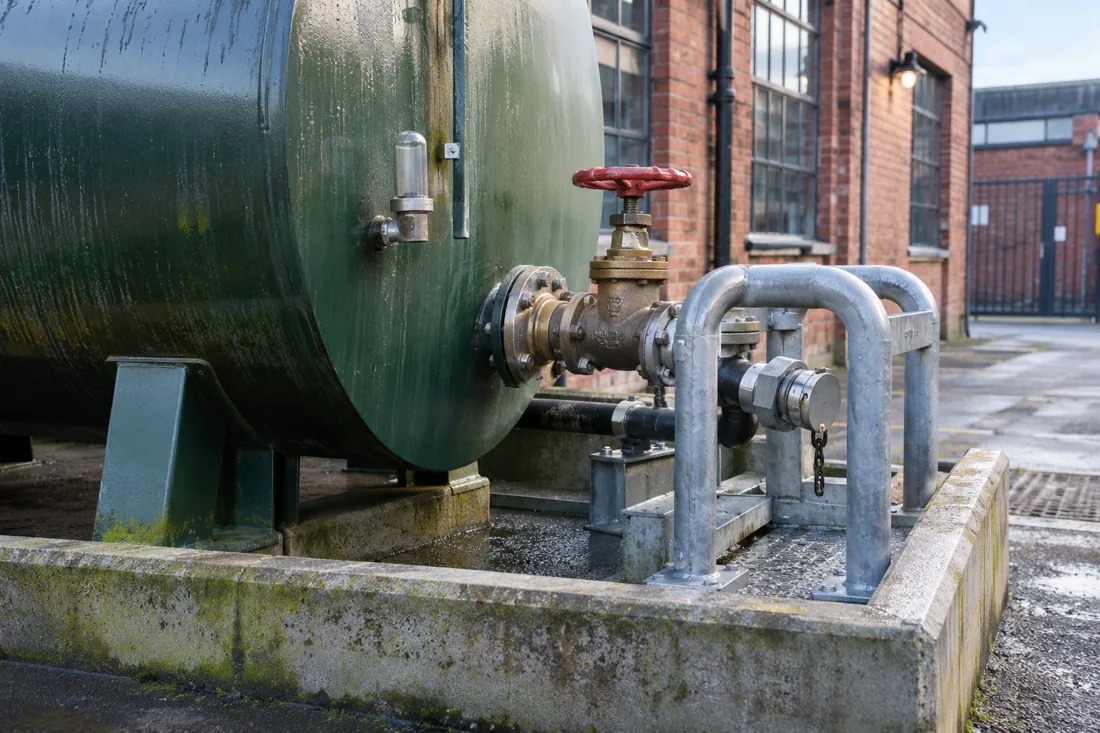
Decide What Decommissioned Must Mean
Tank decommissioning in Manchester should start with a written endpoint. A tank can be temporarily out of service, permanently retired and removed, or retained in place under an assessed scheme. Those outcomes have different consequences for the building owner, future contractors and the land beneath the site.
Disconnecting a supply line does not settle the condition of the tank, its contents or its surrounding ground. A useful scope identifies the complete fuel system, the reason for retirement and the evidence needed at handover. This matters during a property sale or redevelopment, when several parties may rely on the record.
| Future Of The Site | Decision To Make |
|---|---|
| Equipment may return to use | Define temporary arrangements, inspection and responsibility. |
| Storage has no future purpose | Assess permanent removal and redundant pipework. |
| Removal threatens adjacent structures | Assess retention in place and any suitable filling method. |
| Past leakage is suspected | Define environmental investigation separately from making the tank safe. |
Trace The Whole Fuel System
A redundant tank can still be connected to fill pipes, vents, pumps and return lines. Old drawings are helpful, but they may not reflect later alterations. Ask the survey to establish which items serve the tank and which remain in use elsewhere.
The boundary should include any remote fill point and the way future deliveries are prevented after retirement. Buried pipework and shared services need particular care. The specification should say which lines are removed, which are retained and how their final status is recorded.
For a mill conversion or phased factory refurbishment, discuss the construction programme early. Tank work may need to happen before partitions, floors or new services block access. It can also depend on a replacement heating or power system being commissioned first.
Account For Remaining Contents
The fuel quantity and condition affect both the sequence and the price. Product that can be retained needs a suitable receiving destination and a documented decision about reuse. Sludge, water and unsuitable fuel need assessment and an appropriate disposal route.
A tank that has stood unused may contain more residue than its gauge suggests. Previous contents can also be uncertain after a change of ownership. Tell us what is known and what is only assumed, rather than selecting the most likely fuel description.
Do not arrange unplanned draining or let another trade open the tank ahead of the assessment. The method for removing contents and controlling vapour belongs within the specialist work plan. Any sample collection should be arranged through an appropriate person.
Compare Removal With Retention
Where practical, removal takes the vessel out of the future property record as a physical obstruction, though it does not prove the ground is clean. An underground removal needs investigation of nearby services, structural constraints and the excavation. Above-ground removal still needs safe preparation and a workable handling route.
Retention can be considered where removal is impractical, but it is not a shortcut around cleaning or environmental assessment. GOV.UK guidance on underground tank decommissioning explains the issues to consider when taking a buried tank out of use. The site’s proposed use and groundwater risks need to inform the chosen approach.
If a filling method is proposed, request the material specification, preparation requirements and limitations. Foam filling is one possible specialist option for an assessed tank. It does not remove historic contamination or provide a general foundation design for future construction.
Set The Site Controls Before Work
The work plan should cover the shutdown, competent isolation, fuel recovery, cleaning and the assessed treatment of the remaining tank. Fire and explosion risks are considered under HSE guidance on DSEAR where dangerous substances are present. Confined-space entry and lifting may need separate controls.
Send the site postcode, tank photographs and any plans showing its location and connections. Include what it previously supplied, approximate capacity, remaining fuel and whether it is above or below ground. A site survey may be needed where records are incomplete or the physical position is uncertain.
Access information should include vehicle standing areas, basement routes, covers, overhead restrictions and public interfaces. Identify who controls permits and who can approve the final status. On multi-tenant premises, the landlord and affected occupiers may need to agree the shutdown and access arrangements together.
Specify Costs And Evidence At Handover
The main cost drivers are investigation, fuel and waste quantities, cleaning, access and the selected endpoint. Removal adds handling or excavation, while retention may add specialist filling and location records. Ground contamination, demolition and reinstatement should appear as explicit inclusions or exclusions.
Request a completion record that identifies the tank, location, work carried out and any retained pipework. Waste movements need the appropriate records for the classified materials. Atmospheric testing or treatment records should describe the work and its limits, rather than promising that an old tank is safe for every future activity.
Keep the final documentation available for future property work. Mark the retained tank on the asset and site records, including a filled vessel that can no longer be seen. A future contractor needs that information before ground disturbance, loading changes or new foundations are considered.
Your Questions
Is Decommissioning The Same As Removal?
Tank decommissioning is the process of taking a tank out of service under an agreed plan. Removal can be the final stage, but an assessed scheme may leave a tank in place. The quote should state the intended outcome and the records provided, so retirement is not confused with simply disconnecting equipment.
Does Decommissioning Confirm The Ground Is Clean?
Tank decommissioning does not confirm that surrounding ground is free from contamination. Historic losses may have affected soil or groundwater independently of the vessel’s present condition. Tell us about spill records, unexplained stock losses or earlier investigation reports so environmental assessment can be considered alongside the tank work where appropriate.
Start With The Details You Have
Tell us the postcode, the equipment involved and the outcome you need. We can help establish the next step before you commit to a method.
Request A Quote